Tuesday, January 12, 2010

Julia knows her bread

One of my "Santa" presents this year (yes, we still do Santa in this family...) was a DVD collection of Julia Child's The Way to Cook series. Now, I'm not an insane Julia fanatic (Mastering the Art of French Cooking was on my shelf, admittedly, gathering dust, way before Julie & Julia), but I do love me some knife-banging, cream-logged, ooooo-filled cooking every once in awhile.

And there's no time like the new year for some indulgence, right?

Hence, The Bread.

Yes, gut-busting, crust shattering, just-the-right-amount-of-chewy French bread—and not just any golden loaf of splendor, but Julia's exhaustively detailed, hours and hours in the making bread.

Some may scoff at her detail, others may run in horror, but hear me out: the details matter, and when you follow them to a T, you wind up with impeccable stuff. Two winters ago, the Daring Bakers took on the recipe, and they've got great advice and photos (not to mention the whole recipe, word for word, out of Mastering the Art... vol. 2). I followed all of the kneading, shaping and baking directions exactly, but I added a slow first rise in the fridge overnight. This slow rise gives the flour and water more time to incorporate; ferments the dough a little bit, giving the finished product that slight tang so desired in artisan breads; and makes the whole process quite a bit more convenient.

Trendy or not, Julia knows her stuff—this bread is just as good (if not better) than anything I've had in restaurants here, and it is certainly the best I've ever made. So please, bust your gut a little this weekend and make. this. bread.

Seriously.

Monday, January 11, 2010

Smarty Pants


My whipper-smart little sister is the science nerd of the family. My brother and I have managed to emerge from my parents' protective graces firmly entrenched on my mother's artistic side, but she's got her eyes set on pre-med and chemistry and neuroscience and all sorts of other mysterious things. She's also a cook, and for her senior (high school) project, Sally's been taking a cue from meticulous blogger extraordinaire, Carol Blymire, who has taken on some of the country's most challenging cookbooks (and meatballs), by exploring the craft and science of molecular gastronomy.

Basically, she's playing in the kitchen.

I got to help out with one of her experiments over Christmas vacation—we made our version of Alinea's Pheasant, Shallot, Cider, Burning Oak Leaves and served it as a haphazard amuse bouche on Christmas Day.

It was a hit, even with five-year-old Robert (for him, a more apt name for the dish was Fancy Chicken Nugget on a Burning Stick).

Wednesday, December 30, 2009

Farm Fresh

I originally sat down to write this post on December 9. I typed two sentences, thought about a recipe, got up to get a cup of tea, and immediately got distracted by the gigantic epic that was to be my month of December. Whoops.


Long story short, I spent this last month orchestrating the big move back to The South, capital S. There was packing and selling and more packing and driving to be done—and then all of a sudden it was Christmas and I was in North Carolina with my entire extended family and tomorrow is the last day of 2009.


Excuses, excuses.

But now I am back on the couch in my parents’ house, new dog in tow, beginning Job Search 2.0, reminiscing about this


Earlier this month I made a quick trip to Palmetto, GA, for an interview/work day at Serenbe Farms. I dug up sunchokes (aka Jerusalem artichokes), plucked radishes and got super muddy. It was exhilarating spending all day outside, touching and digging and sniffing out delicious food in its most primitive form.

The farm is part of a unique little community being built about an hour south of Atlanta. It’s planned and suburban, yes, but it’s also 100% focused on sustainability, organic farming and alternative ways of interacting with our environment. All of the homes are built to maximize energy retention and minimize carbon footprints. The streets curve in such a way that it takes longer to drive than to walk. The farm and the two restaurants have this amazing exchange program—the farm sells the restaurant excess produce and the restaurants give back their waste in the form of compost—it’s a complete cycle. Most of the residents participate in the CSA program, and the town farmer’s market brings organic foodies from all over each week. The farm even does educational programs with elementary schools in the area, and as far as I’m concerned, the more kids who want to dig in the dirt, the better. The residents have a bit more money than most, but I honestly think that all of this is a good thing. If all of us with the resources to contribute to improving the food system were as conscious about it as those in Serenbe, change would come much faster.


Perhaps one of the best parts of this little jaunt was the schwag I brought home from the interview, like these little guys


Mix together these babies with some spinach (or more seasonal salad greens, preferably dug up from your garden), kohlrabi and a citrusy dressing and you’ve got a salad that’ll brighten up even the snowiest of December days (I’m talking to you, Portland).


Also on my plate is that vegetable tart made with pureed sunchokes, sautéed Swiss chard and onions, and a sprinkling of Parmesan. The onions, olive oil, flour and cheese were from the regular grocery, but almost everything else came from my cold and muddy hands.


Talk about local.

Radish and Kohlrabi Salad with Citrusy Dressing


1 head kohlrabi, cut into a thin julienne using a mandoline or very sharp knife

6-8 French radishes, thinly sliced into transparent rounds
Seasonal salad greens, enough for four people

¼ teaspoon each of grapefruit, lime, lemon and orange zest

about ¼ cup mixed citrus juice (I used lemon, lime and orange)

pinch of brown sugar

olive oil

sea salt

freshly ground black pepper

Assemble radishes and kohlrabi on top of greens. Season with salt and pepper. Mix the zests with the juice and sugar. Slowly whisk in the oil to taste (I like about a 50-50 ratio, but most people find that a bit too acidic). Add salt and pepper. Lightly dress the salad right before serving.


Sunchoke and Chard Tart

Olive Oil Tart Crust (I used Clotilde’s, from Chocolate and Zucchini, with a 50-25-25 mix of all-purpose flour, whole wheat flour and cornmeal)

olive oil
1 pound (I think … Just fill up a cookie sheet…) sunchokes, peeled and cut into 2-inch long chunks
3 cloves garlic, peeled

¼-½ cup stock of your choice

2 bunches Swiss, red, or rainbow chard, stems and leaves separated

2 sweet onions
¼ cup dry white wine

½ cup freshly grated Parmesan cheese

kosher salt


Preheat the oven to 400 degrees. Prepare the tart crust and chill in the fridge for about an hour.


Place the peeled sunchokes on a baking sheet with the garlic cloves. Season with salt and drizzle with a little bit of olive oil (just enough to keep them moist and to prevent sticking). Roast until fork tender (I honestly can’t remember how long I cooked them, but I think it was probably 20-30 minutes). Take out of the oven and let cool until you’re able to touch them without screaming in pain.


Meanwhile, prick the crust all over with a fork, line with aluminum foil and fill with dried beans. Cook for about 7-10 minutes, remove the foil and beans, and cook 7-10 minutes more until ever so golden brown. Let cool until you’re done with everything else.


While the sunchokes are cooling and the crust is baking, chop up the chard stems into 1-inch long pieces and the leaves into bite-sized pieces. Slice the onion into a thin julienne. Heat about one tablespoon of olive oil over medium-ish heat in your biggest and best saucepan. Once it shimmers, add the onion and the chard stems. Saute until they soften and then add the wine. Cook until most of the wine evaporates. Season with salt, and add the chard leaves. Saute until the greens soften and then remove from the heat.


At this point, your sunchokes should be cool enough to handle. Place them and the garlic into the bowl of a food processor. Drizzle in a bit more olive oil and ¼ cup of stock. Puree until smooth, adding more stock and/or oil until smooth. Add about 2/3 of the cheese, pulse to combine and taste for seasoning. Add salt if necessary.


Pour the sunchoke puree into the tart crust. Spread with a spatula so that it evenly covers the tart. Carefully spread the chard and onion mixture on top, again trying to make sure that it is even. Sprinkle the rest of the cheese on top and bake (still at 400 degrees) for about 15 minutes or so, or until everything is hot and bubbly and the cheese is melted and browned.
Let cool for 10-15 minutes so that it doesn’t explode everywhere. Serve with the radish and kohlrabi salad to all of your locavorious foodie friends.

Tuesday, December 8, 2009

Read this

I'll be back in a day or so with some fresh-from-the-farm yumminess, but for now, I advise you to take a look at this:

Serious Eats intern Chici Wang got a chance to listen to Frank Bruni and Jonathan Safran Foer duke it out over meat-eating ethics. She's got a nice synopsis of the event, and I'm totally jealous that she got to take Foer head on.

I'm reading Eating Animals right now and I have quite a few thoughts on it (leaning towards the Frank Bruni/Chici Wang side of the whole argument), but I definitely recommend checking it out.

Saturday, November 28, 2009

I am still stuffed

We learned some important lessons this Thanksgiving.

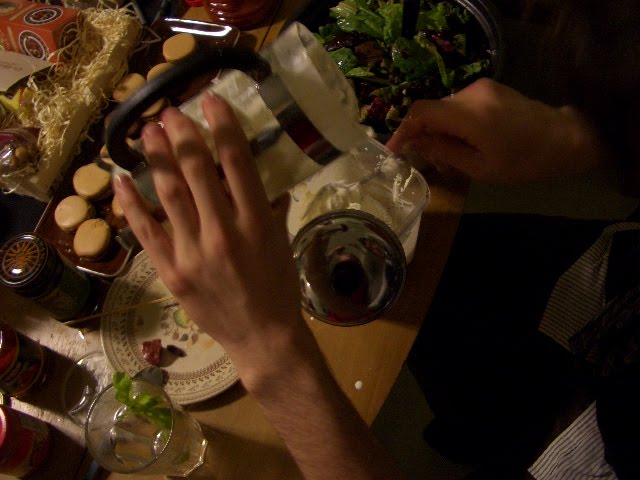
Number one: French press coffee makers do indeed whip heavy cream into glorious submission:


Number two: Homemade appetizers still don't get eaten unless they are a) decor for bloody marys (celery, cheese, olive, sausage, surprisingly appropriate) or b) macarons (espresso and salted caramel, explosively delicious):


Number three: Turkeys cooked in a roasting rack do sometimes look like torpedos:


Number four: Eight Thanksgiving servings are always smaller than eight regular servings. We would all have to eat like this:


(and then some) to eat all of this:


(I still don't know where Ted's sausage-walnut-sage stuffing went. It was delicious, I promise).

Thursday, November 26, 2009

Happy Thanksgiving!


For the first time in three years, I will not be cooking a turkey or manning a kitchen on this, the best of Thursdays. Instead, I am whipping up some winter squash soup, cranberry sauce and a pecan pie, traveling across southeast to eat with a smaller group of friends. Relaxing and somewhat strange, I'm sure that it will still be a deliciously gluttonous evening.

Whatever your plans today, travel safe, eat well, and laugh. A lot.

Thursday, November 19, 2009

Comfort(able)

Late fall in Portland begs for soup. It pleads for steaming bowls, big spoons and a leisurely dinner spent slurping. It commands us to spend extra time and care in front of a hot stove, stirring, smelling, tasting until we achieve, night after night, the perfect blend of warmth and silky satisfaction.

It’s the wet and the cold and the drafty windows that do it. The chill brings bone-numbing shivers, demanding that we pull out the raincoats and the rain boots and the umbrellas (for the non-natives). It makes us run inside to bars, coffee shops, movie theaters and creative combinations of the three. It causes us to complain, but it also makes us stronger.

Lest we forget, it’s the long months of rain that bring us the red and the yellow of carrots and squash and apples demanding to be transformed into comfort. It’s the long months of rain that bring us rows upon rows of hearty winter greens, the mysterious stalks of Brussels sprouts and the fractal beauty of romanesco.

If we can brave the soaked markets and the puddle-filled parking lots, it is with pleasure that we should take a few more minutes to roast that squash, caramelize that onion and stew those greens, melding all of these wonderful autumnal flavors to create a bowl of goodness more special than even the sum of its parts.

Take first, for example, warm cabbage salad (for which I am eternally indebted to Heidi Swanson):

Bitter, raw, crunchy vegetables take a warm dip in oil, vinegar, raisins and spices to emerge just ever so wilted, ever so sweetened, ever so royal.

Or next, pile warm stewed kale on top of a thick slab of homemade toast and drench with the runny yolk of a just-cooked over easy egg (oh, Orangette, you are so very wise):

Yet my favorite this November has been the bowls upon bowls of winter squash soup. I’ve made it with whatever orb strikes my fancy–pumpkin, butternut, acorn, delicata–stewed with everything from apples to sage to shallots, sometimes with water, sometimes with chicken stock, sometimes with leftover bean cooking liquid. I’ve found that the best soups come from a roasted squash, a single fresh herb profile, a bit of apple and a splash of acidity. The flavor lingers, complex but not overwhelming, and matches perfectly with all of the above.


Roasted Winter Squash Soup
Very loosely adapted from Serious Eats
Serves about 4, depending on sides


1 medium or a couple smaller winter squashes (I like the combination of acorn and delicata), cut in half with the seeds scraped out (save to roast for a snack!)
Olive oil
½ sweet onion, chopped
2 cloves of garlic, minced
about ¼ cup dry white wine
2 apples, on the tart side, cored and chopped
about a 1-inch segment of fresh ginger, smashed with the side of a kitchen knife
1 clove, stuck into the segment of ginger
about 6 cups chicken (or veggie) stock
pinch red chili flakes or cayenne pepper
juice of half a lemon
kosher salt and fresh-ground pepper

Preheat the oven to 375 degrees. Generously salt the halves of squash, rubbing the salt into the flesh. Place on a baking sheet, cut side up, and roast for about 20-30 minutes (depending on size), until the tines of a fork can pierce the flesh easily.

Meanwhile, heat a good glug (about 1 tablespoon) of olive oil over medium heat in a good soup pot (I use my Le Cruset). Add the onion, sprinkle with salt, and sauté until softened. Add the garlic and sauté for about 30 seconds, or until you can smell it. Add the wine and let it reduce until almost evaporated.

At this point, if the squash isn’t done, remove the pot from the heat. Once the squash is cooked, let it cool just until you can handle it without burning yourself (this has never happened to me…). Gently peel the skin away from flesh, trying not to smash up the soft squash all over the counter (again, never happened…). Cube the squash and add it to the soup pot along with the apples, ginger, clove and stock (I usually just add enough to cover all of the other ingredients. You can always add more back in at the end if the soup is too thick). Gently bring up to a simmer, cover, turn down the heat to low-ish and simmer until the apples are cooked all the way through.

Once everything is cooked to your liking, remove the pot from the heat and (carefully, in batches!) puree in a blender or food processor. (Make sure to only fill up your blender/processor about 1/3 of the way and make sure to blend slowly. You do not want a soup-covered kitchen–trust me. It helps to have another bowl or handy for your pureed soup. If you are lucky enough to have an immersion blender, use it!) After pureeing the last batch, return the soup to low heat. Add chili flakes/cayenne to taste, lemon juice and extra stock if the soup is too thick. Taste for seasoning and add salt if it needs it.

Serve with wilted salad, stewed greens or a grilled cheese sandwich.

Drink a hot toddy. Cuddle.